

Finland's plan to bury nuclear waste carries risk to future generations
Finland's plan to bury nuclear waste carries risk to future generations
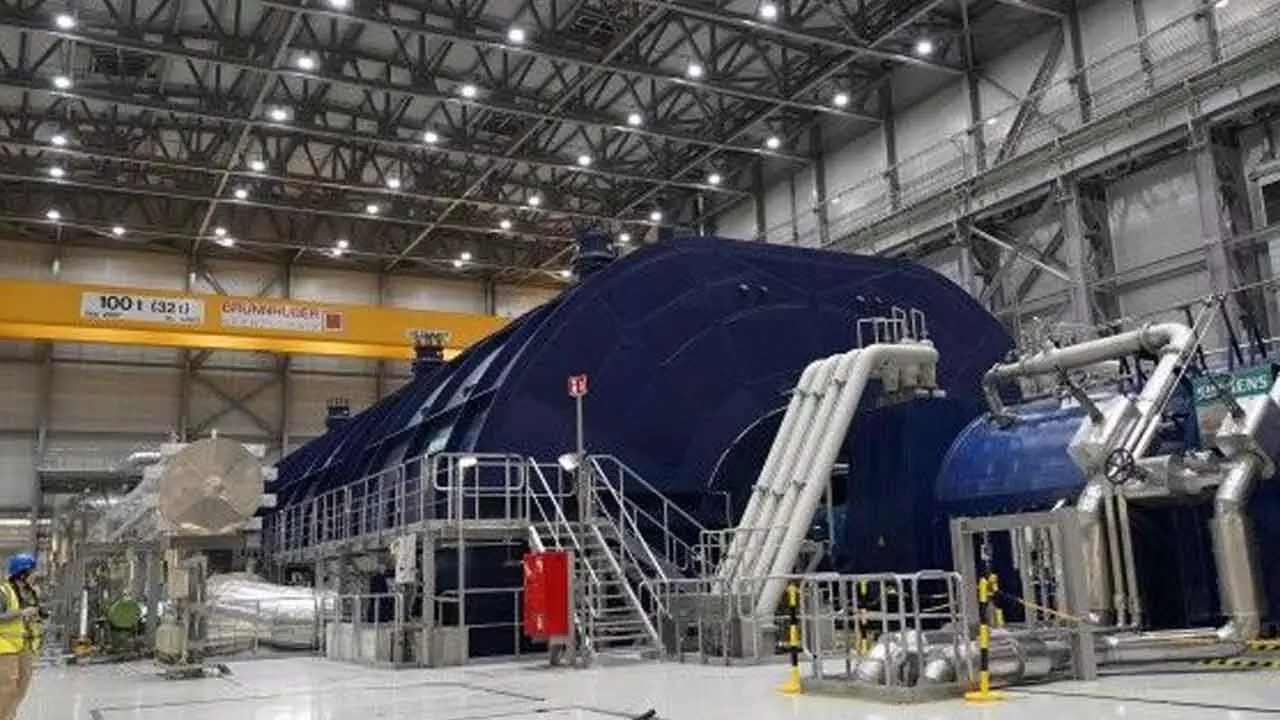
Olkiluoto (Finland), Apr 9 (AP) With the push of a button, the elevator descends hundreds of meters in seconds into the dark depths of Onkalo.
“We are now at about minus 430 meters (1,411 feet),” muttered geologist Tuomas Pere as he steered a car through a laby-rinth of man-made tunnels. “We are driving through 1.9-billion year old bedrock.”
After decades of construction, the world's first facility for permanently disposing spent nuclear fuel is set to begin opera-tions in Finland, becoming a final resting place for tons of dangerous radioactive waste.
Construction of Onkalo — which means “cave” in Finnish — began on the west coast in 2004. It sits on the secluded is-land of Olkiluoto, in a dense wooded area. The closest town is Eurajoki, about 15 kilometers (9.3 miles) inland, which is home to about 9,000 people. Many work at the nuclear power plant or storage facility.
The 1 billion euro ($1.2 billion) project could soon become operational, with authorities expected to grant a license with-in months.
The Associated Press took a tour of the facilities where humans soon will not be allowed to tread.
Isolated from civilization'
Pere said the site — near three of Finland's five nuclear reactors — was chosen for its migmatite-gneiss bedrock, which is known for its high stability and low risk of earthquakes.
“It's the isolation from civilization and mankind on the surface that's important,” he said, standing in a darkened disposal tunnel, soon to be sealed from humanity. “We can dispose of the waste more safely than by storing it in facilities located on the ground.”
Using unmanned machinery at a nearby encapsulation plant, radioactive rods will be sealed in copper canisters and then buried deep in tunnels over 400 meters underground, then packed in with “buffer” layers of water-absorbing bentonite clay.
Posiva, the company responsible for the long-term management of Finland's spent nuclear fuels, says Onkalo can store 6,500 tons of spent nuclear fuel.
The final disposal canisters are designed to remain sealed “long enough for the radioactivity of spent fuel to decrease to a level not harmful to the environment,” it said.
“The solution that we have, it's the missing point for sustainable use of nuclear energy,” said Posiva communications manager Pasi Tuohimaa.
Finnish nuclear power companies are paying for the project, he said, adding that they have saved money for decades for that purpose.
Posiva estimate it will take hundreds of thousands of years before the radioactivity falls to normal, background levels.
According to a 2022 report by the International Atomic Energy Agency, almost 400,000 tons of spent fuel have been pro-duced globally since the 1950s, with two-thirds remaining in temporary storage and one third being recycled in a com-plex process.
The world's spent nuclear fuel is currently temporarily stored inside spent nuclear fuel pools at individual reactors and at dry cask storage sites above ground.
There is currently no permanent underground disposal facility for commercial nuclear waste operational anywhere in the world. Sweden began building a repository in Forsmark — about 150 kilometers north of Stockholm — last year, but it's not expected to open until the late 2030s. France's Cigéo project is yet to begin construction and has seen opposition.
The Onkalo facility is expected to operate until the 2120s, when it will be permanently sealed.
There are uncertainties'
But Edwin Lyman, director of nuclear power safety at the Union of Concerned Scientists, an American nonprofit organi-zation, warned that geologic disposal of nuclear waste is still fraught with “uncertainties.”
“My view of nuclear waste disposal is that there's no good option, but it's important to find the least bad option, and geo-logic disposal in general is going to be the least bad option among a range of, you know, bad options,” he said. Lyman said that the copper canisters that contain the spent nuclear fuel will eventually corrode, adding that there are dif-ferent scientific opinions about how fast that could happen.
“The hope is that is such a slow process that most of the radioactive material will have decayed away by then. But again, there are uncertainties,” he said.





